REVIEW · DUBLIN
Small Group Bucket List Sights Walking Tour with a Local Guide
Book on Viator →Operated by Yellow Umbrella Tours Ltd · Bookable on Viator
Dublin makes sense on foot. This small-group walking tour strings together the city’s big-name sights into one smooth arc, with a local guide who explains how the old and the new grew side by side. I especially love how the route is built for first-time orientation, and how the stories connect buildings to real moments in Irish life.
I also like that the pacing is built around short stops, so you’re not stuck in one place too long. One thing to consider: several stops are outside-only, with admission not included at places like Christ Church Cathedral and St. Patrick’s Cathedral, so plan extra time or money if you want interiors.
In This Review
- Quick hits before you set out
- Why this 2-hour Dublin highlights walk works
- Price and what $20.52 buys you
- Where you meet and how the walk is paced
- Christ Church Cathedral and St Patrick’s Cathedral: two eras in stone
- Dubh Linn Gardens: a quieter reset between big landmarks
- Dublin Castle, City Hall, and the flag lesson you can’t unsee
- Temple Bar to Ha’penny Bridge: pubs, power, and a shaking legend
- Merchant’s Arch to Trinity College: finance, famous statues, and Book of Kells energy
- The real payoff: how the guide turns stops into a story you can repeat
- Should you book this tour?
- FAQ
- How long is the Dublin walking tour?
- What stops are included on the route?
- Are admission tickets included for the stops?
- Where do you meet, and where does the tour end?
- What time does the tour start?
- Is the tour offered in English?
- Can I cancel and get a refund?
Quick hits before you set out
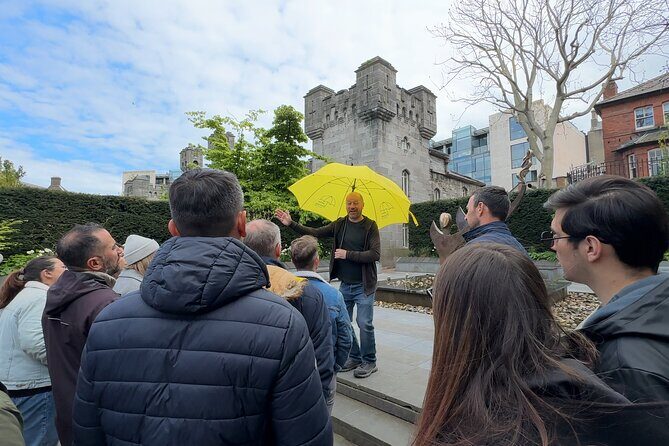
- Small-group size (max 25) keeps questions easy and makes the walk feel personal
- 12 major stops in ~2 hours gives you fast orientation in Dublin’s center
- Bridges and views included: Millennium Bridge east-to-west perspective, then back over Ha’penny
- Politics shows up in plain sight at Dublin Castle and City Hall with the national flag explained
- A good finish at Trinity College so you know what to do next, including the Book of Kells area
Why this 2-hour Dublin highlights walk works
If you have a short stay, this tour does something smart: it groups Dublin’s most recognizable stops into one walkable loop. You start near Wood Quay, then end on College Green outside Trinity College, so you finish right where most day trips and museum plans begin.
The value here is in the way the guide ties sights to context, not just facts. Expect a lot of discussion about how Dublin changed as new powers arrived and locals adapted. In past runs, guides like Peter, Martin, and Rob have stood out for keeping the tone friendly and encouraging questions, which matters when you’re trying to learn fast without feeling rushed.
Because each stop is about ten minutes, you get a taste of each place and a sense of where everything sits on the map. I like that approach for Dublin, where the streets can feel close but the eras feel far apart. You’ll leave with your bearings—and with a short list of places worth revisiting when you want to go deeper on your own.
You can also read our reviews of more walking tours in Dublin



Price and what $20.52 buys you
At about $20.52 per person for roughly 2 hours, this is priced like a practical orientation tour, not a ticket bundle. You’re paying mainly for a live local guide plus the planning that stitches together the most useful sights in the shortest walking time.
The key value trade-off is admission. Some stops are free to enjoy from the outside or in the public areas, but several require separate tickets if you want to enter (Christ Church Cathedral, St. Patrick’s Cathedral, and Dublin Castle are called out as admission not included). If you prefer to look from the sidewalk and focus on stories, you’ll feel like you got a bargain.
Also consider the timing: the tour is popular, with an average booking window of 61 days in advance. If your dates are set, book early so you’re not stuck hunting last-minute slots.
Where you meet and how the walk is paced
You meet at 121 R137, Wood Quay in Dublin, starting at 10:00 am. The tour ends at Fox House, 37 College Green, outside the front gate of Trinity College Dublin, which is a great landing spot if you’re planning to continue exploring that part of the city.
With a maximum of 25 people, you should expect a manageable group size where questions don’t get swallowed. Most travelers can join, and the tour is offered in English. If you’re traveling with a service animal, they’re allowed here.
The biggest practical tip: treat this as a highlights orientation, not a deep-building experience. Even though there are famous landmarks everywhere you turn, the structure keeps each stop short, so you can cover a lot without spending your whole morning in lines.
Christ Church Cathedral and St Patrick’s Cathedral: two eras in stone
Your first stop is Christ Church Cathedral, with an origin story that stretches from Viking wood building to Norman stone, then a 19th-century renovation tied to whiskey money. Even without going inside, the guide’s explanation helps you read the cathedral as a timeline rather than just a pretty stop.
Then you head to St. Patrick’s Cathedral, named for the patron saint story about driving snakes off the island. The Guinness family’s 1860s renovations come into the picture too, which is a nice reminder that Dublin’s big history doesn’t only come from kings and battles—it also comes from powerful families and philanthropy.
A useful consideration: both of these cathedrals list admission as not included. That means you’ll likely spend most of your time looking and listening outside, unless the tour moment lines up with you buying separate tickets. If you do want interiors, you may need to budget extra time after the tour.
Dubh Linn Gardens: a quieter reset between big landmarks
Stop three is Dubh Linn Gardens, the kind of place you’re glad to have after churches and streets full of tour noise. The gardens sit near the Chester Beatty Library, and the tour frames this location with a Viking arrival detail: it’s where long boats were moored when Vikings came to Dublin in the 9th century.
What I like about this stop is the contrast. The tour keeps pushing major landmarks, but this garden break gives your brain a breather and gives you a different lens on early Dublin. It also helps you understand the city’s relationship with the river, which keeps popping up again at the bridges.
Because the gardens are listed as free, this is a low-cost payoff point on the route. Even if you skip any library time, you can still enjoy the garden area as part of the story the guide is building.
You can also read our reviews of more guided tours in Dublin




Dublin Castle, City Hall, and the flag lesson you can’t unsee
Next comes Dublin Castle, described as a center of British government in Ireland for 700 years, with a mash-up of styles—medieval, Georgian, Gothic, and modern. This is where the tour’s “Dublin as a layered map” approach really clicks. The guide helps you understand why the site matters beyond architecture.
Right beside City Hall, you also stop to talk about the national flag and how it symbolizes peace between Catholic and Protestant communities, and between North and South. It’s one of those moments where a small detail (a flag you’ve probably seen before) becomes a quick lesson in what Ireland has been trying to heal.
Admission at Dublin Castle is not included, so think of this segment as observation and explanation rather than a full interior visit. That said, the outside context can still make the place feel more grounded, because you’re not just staring at walls—you’re learning why those walls mattered for centuries.
Temple Bar to Ha’penny Bridge: pubs, power, and a shaking legend
Stop six is Temple Bar, one of Dublin’s oldest areas, now strongly associated with pubs and nightlife. The guide ties it to the Tudor conquest era layout, which helps the neighborhood feel less like a theme and more like a historical stage set.
Then the tour crosses to views from the Millennium Bridge. This is a strong “look both directions” moment: east brings the story of the Celts building a settlement about 2,100 years ago, while west points toward the modern idea of the Silicon Docks, inspired by Americans about 21 years ago. You’ll get city context without needing to read a single sign.
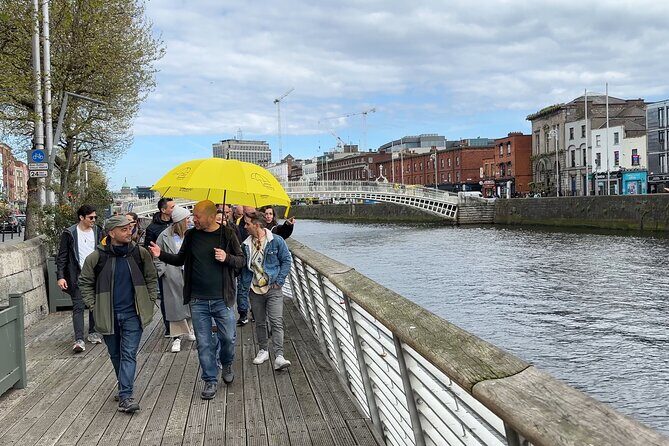
Finally, you head back over Ha’penny Bridge. It used to be named after the Duke of Wellington, and the tour credits Harland & Wolff for making sure the bridge no longer shakes when you walk over it. That bit of trivia is the kind of thing you’ll remember when you’re back in traffic and trying not to trip over your own shoes.
Practical note: several of these stops are listed as admission not included, but that’s not a problem here. The real focus is the streetscape, the bridge views, and the guide’s connections between the eras.
Merchant’s Arch to Trinity College: finance, famous statues, and Book of Kells energy
Stop nine brings you to Merchant’s Arch, where Dublin is framed as contrasts: Crown Alley on one end, and the brutalist Stephenson Tower on the other. The point is less about judging styles and more about seeing how the city keeps re-inventing itself while staying recognizable.
Then you reach College Green, known for major buildings tied to finance and government. The tour describes the area as the center of power in a city that considered itself the empire’s second city. Whether you’re into politics or not, this stop helps you understand why Dublin’s central streets feel so official.
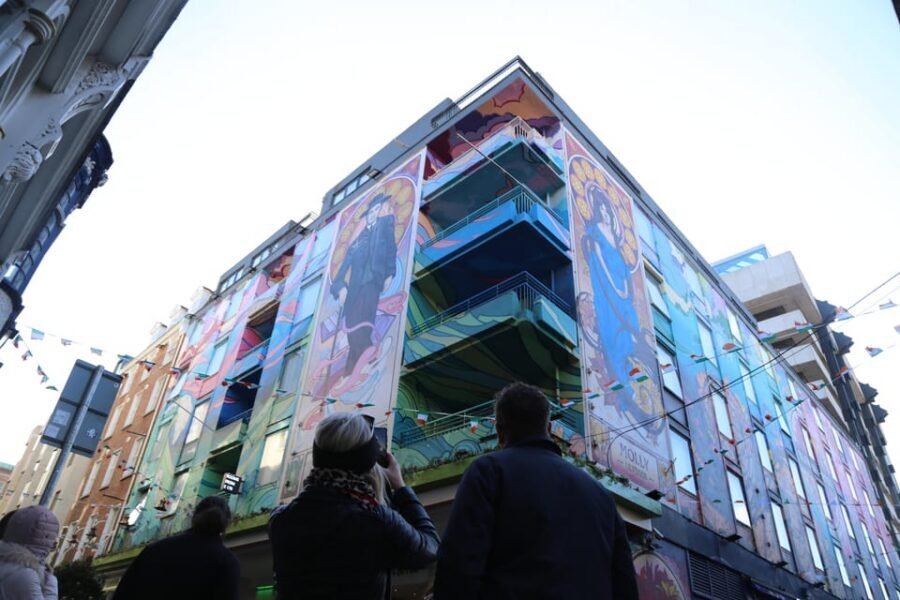
Next is a fun photo moment: the Molly Malone Statue. It’s brief, but it matters because the tour uses it as a cultural anchor—your quick hello to one of Dublin’s most famous characters.
Finally, you end at Trinity College Dublin, finishing outside the gates near Fox House. The guide points you toward Trinity’s Book of Kells exhibition, which is useful if you’re deciding how to spend the rest of your day. Even without stepping inside during the tour, you’ll know exactly where to aim.
Again, these are largely outside-looking-and-learning segments, since admission isn’t included for most of the final stops.
The real payoff: how the guide turns stops into a story you can repeat
What makes this tour worth it is the way it connects the dots. Churches aren’t treated as isolated icons. Bridges aren’t just photo spots. Dublin Castle isn’t just a pretty structure. Each one gets placed into a bigger picture of who had influence, who adapted, and how the city’s identity formed.
I also like that the tour format encourages questions. That matters because Dublin’s story can sound complicated until you hear it in a simple walking sequence. When you can ask follow-ups, you get personalized clarity: why a street name matters, how a renovation shaped how people saw a landmark, or what a symbol like the flag is trying to communicate.
Finally, the walk sets you up to explore after. Since you finish at Trinity College on College Green, you’ve got an obvious next step. If you want museums, bookish sights, or just more wandering, you’re already in the right zone.
Should you book this tour?
Book it if you want a fast, practical introduction to central Dublin without spending the whole day in lines. The small-group size, the tight route, and the way the guide links sites to Irish political and social context make it a smart choice for a first visit or a short break.
Skip it (or plan differently) if you strongly want to spend lots of time inside major buildings right on the walk. Since several stops list admission as not included, you may need to add tickets and time after the tour to get the full indoor experience.
If you like your travel guided, but still want to roam on your own afterward, this is a solid pick.
FAQ
How long is the Dublin walking tour?
The tour lasts about 2 hours.
What stops are included on the route?
The tour includes Christ Church Cathedral, St. Patrick’s Cathedral, Dubh Linn Gardens, Dublin Castle, City Hall, Temple Bar, Millennium Bridge, Ha’penny Bridge, Merchant’s Arch, College Green, the Molly Malone Statue, and Trinity College Dublin.
Are admission tickets included for the stops?
Admission is listed as not included for Christ Church Cathedral, St. Patrick’s Cathedral, and Dublin Castle, and as not included for other sights like Millennium Bridge, Ha’penny Bridge, and Trinity College Dublin. Dubh Linn Gardens and City Hall, Temple Bar, and College Green are listed as free.
Where do you meet, and where does the tour end?
You start at 121 R137, Wood Quay, Dublin, Ireland and end at Fox House, 37 College Green, Dublin 2, outside the front gate of Trinity College.
What time does the tour start?
The start time is 10:00 am.
Is the tour offered in English?
Yes, the tour is offered in English.
Can I cancel and get a refund?
Yes. You can cancel up to 24 hours in advance for a full refund.